
Design tips for engineering websites that convert visitors into qualified leads. Build trust, get inquiries, and grow your industrial business.

Picture a Monday morning. A procurement engineer at a large machine builder has a specific technical problem to solve, and your company handles exactly that kind of work. Better than most of your competitors. He finds your website, clicks through a few pages, and leaves. No inquiry, no call. He moves on to a competitor whose site made it easier to see they were the right fit.
For many established manufacturers, their website looks perfectly fine: clean, professional, up to date. The problem is that was never designed the way a technical buyer actually reads and decides: the information he needs is buried, the proof he wants isn't where he expects it, and the next step isn't obvious. A capable supplier loses the job to a weaker one, simply because the weaker one's site was built around the buyer.
This guide is about closing that gap; with design choices you can check on your own site today. If you suspect your current site is the problem, this is worth reading first: why your industrial website isn't generating leads.
What makes an engineering website convert visitors into leads?
First of all, let's clarify what we mean when we say “a successful engineering website”. In order to achieve success in a very competitive market, a website should provide a steady source of inquiries from the exact buyers who need them. Technical businesses face strict rules in relation to marketing; therefore, it’s important to create a website that not only reflects what you do but also attracts buyers in the right way. This article is a guide on creating a great website using proven design principles based on the practices of the most successful companies.
How to define conversion goals related to your engineering sales cycle?
The first step is to identify the actions that are most valuable in relation to the technical products you offer. For most industrial companies, those are:
Requests for quotation (RFQ) or project consultations
Email inquiries
Prequalification or vendor registration inquiry
Downloads of datasheets, drawings or product catalogues
Booking a call or a demonstration
Live chat conversations about specifications, pricing, and availability
A well-built site quietly guides visitors toward these actions through the right content and an easy path through the pages.
How to define a qualified lead for a technical B2B company?
As has been mentioned above, the target audience should be defined carefully as not every visitor or inquiry is worth the same. Your website is supposed to attract people who are in demand and need what your company offers them. Here are some examples:
An operations manager who needs a custom-engineered product
A purchaser who requires the specifications or certificates
A project engineer who is evaluating your capabilities and previous achievements
A distributor checking whether you fit his local market
The goal is the right inquiries from the right people, not simply more of them.
Why transparency builds trust with technical buyers
Engineering professionals have to make tough decisions which they are going to justify afterwards. This is why they tend to believe in evidence rather than slogans and advertising messages, that seems to be biased and false. They appreciate the transparency of the process of purchasing your products, the way you operate and your results. In order to achieve maximum credibility, make sure your website makes it easy to find that proof, the next step, and a clear way to get in touch. Put your results, certifications, and customer references where people can see them, and skip the vague, salesy claims.
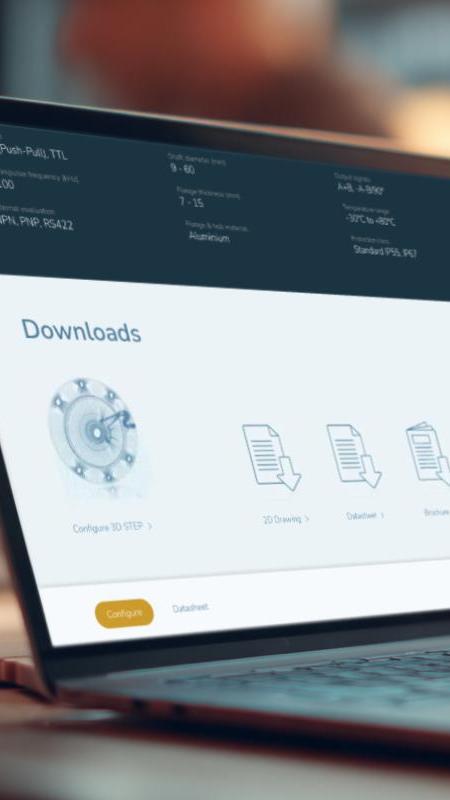

Important principles for designing websites for technical companies
An industrial buyer comes to your site with a job to do: figure out, fast, whether your company can solve their problem and what to do next. The pages that bring in inquiries are simply the ones that make that easy, and a handful of practical choices make the difference.
Key website elements to promote industrial solutions
Element | What it's for | Best practice | Common mistake |
|---|---|---|---|
The first thing people read | State your expertise instantly | A clear, specific offer at the top of the page | Vague or generic messaging |
The “next step” button | A button providing a next step in the purchasing process | One focused action per page | Several competing buttons |
Example projects | Prove results and know-how | Measurable results with real client context | Hard to find or hidden |
Contact form | Turn interest into an inquiry | A few relevant questions; a word of reassurance | Too many or irrelevant fields |
Certifications | Your compliance and reliability as a supplier | Next to buttons, forms, and service descriptions | Only on the 'About' page |
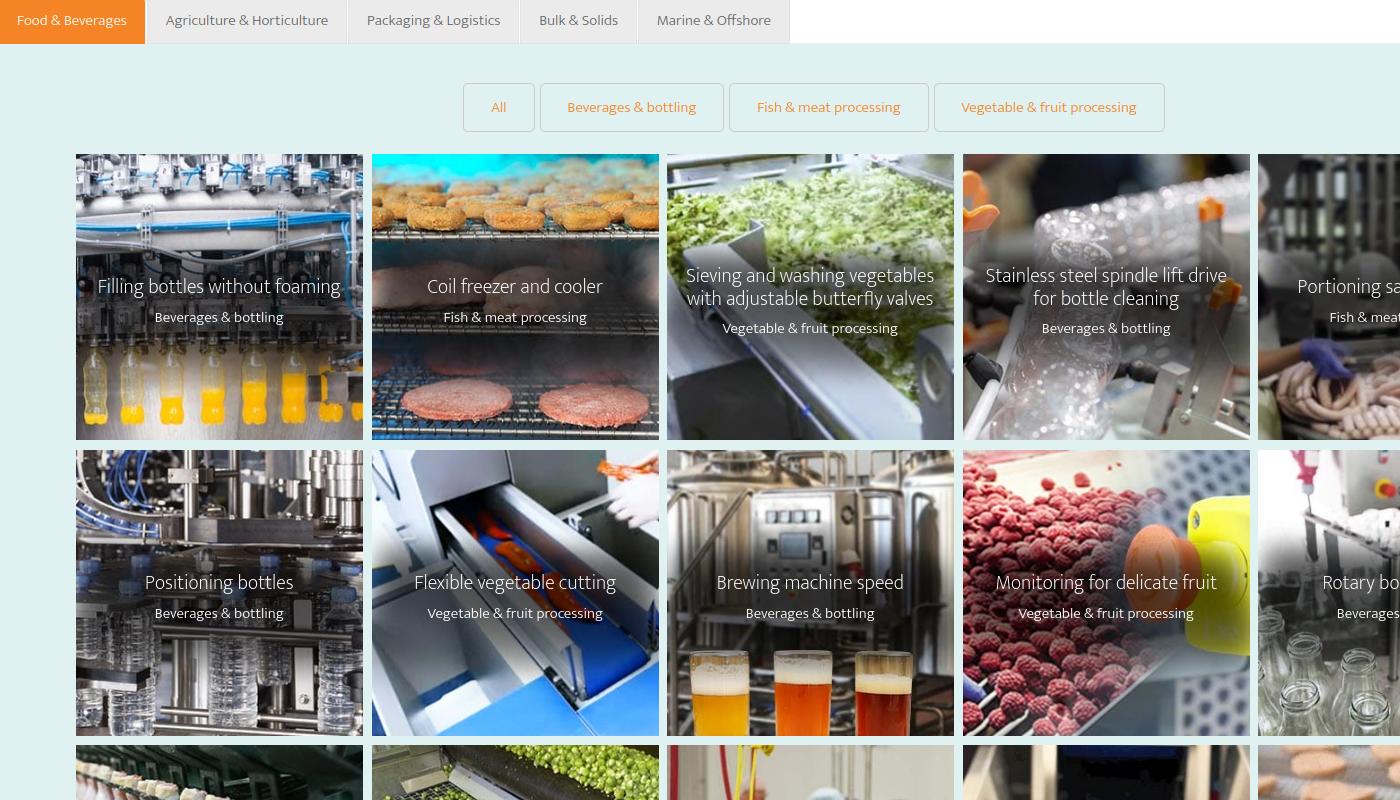
Engineering website conversion checklist
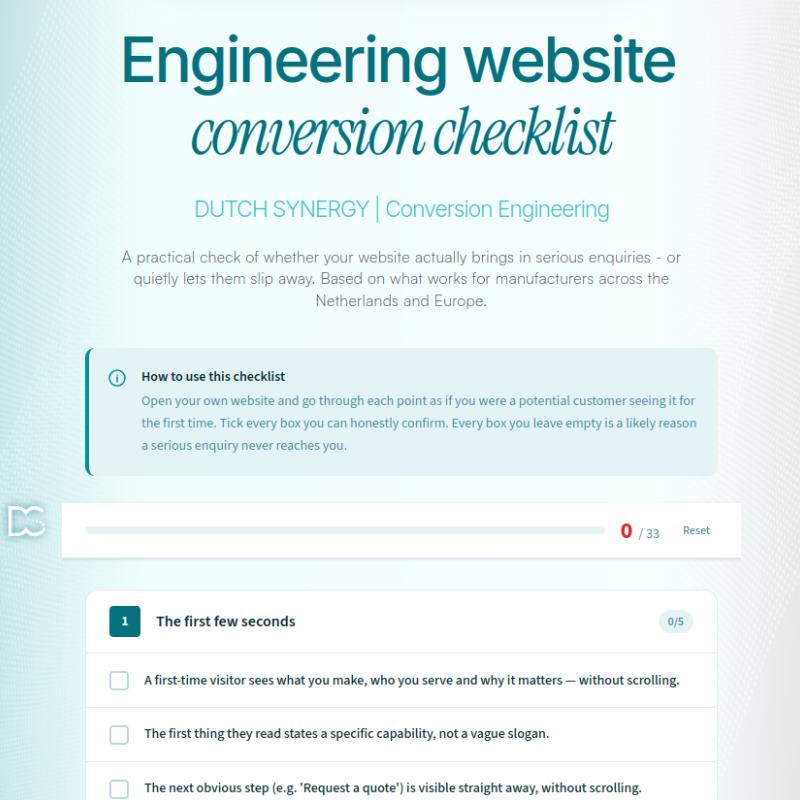
Before you make any change to your website, see how the current site holds up. Use our free engineering website conversion checklist to see what prevents your website from bringing conversions. You can perform this quick check right now.
33 checks across the six things that decide whether technical buyers turn into real inquiries. It takes about ten minutes and shows you exactly which gaps to fix first.
For advice specific to your business, consider booking a strategic marketing consultation to discuss where your website is losing inquiries and what to do about it.
Trust signals engineering buyers expect to see
Industrial buyers want solid evidence before they commit to a supplier. Give them several reasons to trust you, spread across the site.
Relevant certifications and standards
ISO, CE, and other accreditations should be easy to see right where people decide, near the inquiry buttons and contact points. Provide the relevant accreditation: NEN/EN for the Dutch customers and accreditations recognized in the country in which you export (DIN – Germany)
Your expertise
Provide detailed information about your experience. Also mention the flagship projects that you have completed successfully.
Testimonials and logos
Introduce some of your well-known customers. State what they thought of your services and what results they gained during cooperation with your company.
Safety and quality
Indicate what security norms you follow in your company and mention if there are any ongoing quality improvement initiatives implemented in your engineering company.
How to design an industrial website for international credibility
For a number of European manufacturers, expanding the business overseas is the most important factor. This is why the design of the website has to correspond to the image of a business that sells across Europe.
A website that shows clearly being a national supplier with English added to it, makes a company a regional player rather than the international specialist that it is. A person from a neighbouring country will easily figure it out that the website owner failed to care about him and his market. International reputation should be maintained through design and the following elements will help you to do it:
Each language version of your website should be equally polished. The texts written in the language of your future customer tells that you work in their market.
Provide the proofs relevant to the market you are going to conquer. Show your accreditations and other proof material that your future customer understands. Provide evidence of work done in his region. NEN/EN certifications reassure a Dutch engineer; a German purchaser looks for DIN certification and standards.
Show your global reach through the evidence. Use a phrase like “delivering solutions across the Netherlands, Germany and Scandinavia” or add a map of your project locations.
Technical words in every language must sound correct to the engineer reading the site. Providing the accurate technical information proves that you know your business and is one of the greatest signs of credibility.
With the right combination of these elements, your website will stop telling about you as about a regional specialist but rather as an experienced cross-border company operating in the market of your customer.
Content and messaging principles that drive technical leads
The content of the website should focus on clear benefits, mentioning the actual problem of your target audience and explaining how your company is going to solve it. Focusing on results rather than features.
Address the real problem of your audience
Use the words and phrases that they would use themselves, for example: “Aging automation systems mean more downtime and failed audits”.Explain technical services
Avoid vague description when dealing with technical products. The more understandable description you use, the easier your clients will understand your business and will want to collaborate. “We supply PLC-based control panels with full on-site installation, commissioning and training in the local language”.Focus on result-oriented content
The way of presenting your engineering services should be oriented at the advantages you offer. Don’t describe the service itself but rather describe the benefit the way your buyer would measure it. Use measurable phrases such as “Increased throughput by 18% through predictive maintenance”, “Boost throughput without adding floor space”. If possible, relate the increase in your clients' profits to such indicators as output or yield.
Always make the value of the next step clear, whether that's sending an inquiry or downloading a white paper.
Common engineering website mistakes that cost you leads
Most of the technical businesses are unable to attract more buyers because of some design mistakes they’ve made in the process of building their website. These include the following ones:
Too much jargon that makes the reader confused
No clear next step, so visitors don't know what to do
A complicated menu that slows people down and gets in the way
Slow loading from heavy images or code, loses visitors on a phone
No visible proof, no testimonials, no certifications
Outdated or too detailed content that loses trust
Check your website regularly and update the design accordingly to the numbers that you receive. Do you want to be found not just in Google but in AI-generated answers too? That's a closely related challenge: see how to get more leads from ChatGPT and other AI platforms.
Everything you need to know
Frequently Asked Questions about
engineering website design and lead generation
What should an engineering website include to generate leads?
What is the best call-to-action for an engineering company?
What makes an engineering homepage convert better?
How can engineering companies build trust online?
Should engineering websites use case studies?
How much does an engineering website cost
How to optimize a technical website for mobile users?
How to create a technical website for international buyers?
Conclusion
The key to a steady flow of qualitative inquiries comes down to combining real engineering skills with a thorough marketing approach. All guidelines of our article are based on measurable results across international markets. When you're ready to transform your underperforming website into a profit-generating source that brings in leads, compare your website with the described principles, or book a strategic marketing consultation for advice tailored to your business.