Your industrial website attracts visitors but not customers? Discover how technical businesses use their site as a lead machine and stop leaving revenue on the table.

Your industrial website attracts hundreds of visitors every month, but the last qualified enquiry came weeks ago. Sound familiar?
The problem you are probably not seeing
Your industrial website has been live for a while. The technology works, the design looks professional, the information is complete and accurate. Yet remarkably little happens. No leads in the inbox. Few demo requests. Barely any whitepaper downloads.
Meanwhile, procurement specialists, engineers and technical directors visit the site. They are prepared to make significant investments. They are looking for solutions like yours. They land on the homepage and leave without taking any action.
The frustrating part? You often have no idea they were there at all. We see this pattern consistently with our clients in manufacturing before they start working with us.
Research from the Content Marketing Institute shows that 47% of B2B buyers review three to five websites before contacting a supplier. According to Forrester Research, 68% of B2B buyers begin their search online.
While you are looking for customers through trade shows, cold outreach and networking, your competitor is systematically building an online lead stream with clients you could have been reaching.

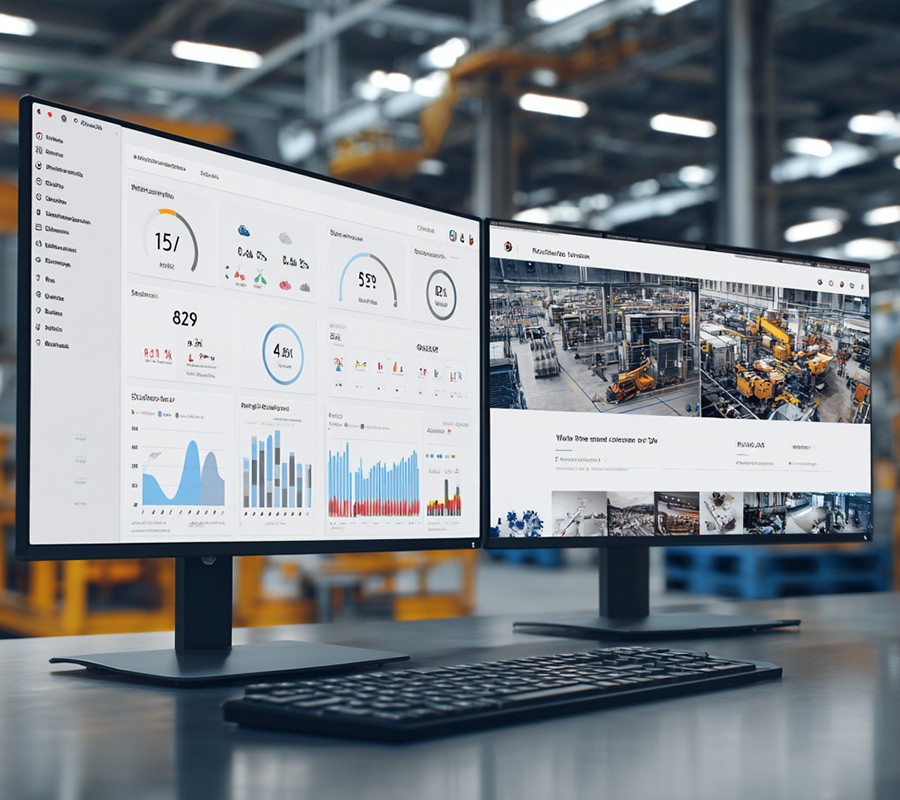
Why your website is not performing (and it is usually not the design)
"Our website needs a more modern look." "We need more professional photography." "The copy needs to be more compelling."
This instinct is understandable, but it misses the point. The real issue: a redesign without an underlying strategy is like respraying a car with a broken engine. It may look better, but the performance stays the same.
The website does not convert because there is no considered plan to turn visitors into leads.

Why industrial websites fail to generate leads: 6 root causes
Many industrial sites are missing the basic principles of effective lead generation.

What a non-converting industrial website actually costs you
The cost of a website that does not perform is invisible, until you calculate what you are missing out on.
Every month your website fails to convert, you lose more than just potential customers. You miss opportunities to talk to prospects who are actively searching for solutions like yours. You lose ground to competitors who have a strategic online approach. And you leave revenue on the table that was within reach.
A machine builder with 500 website visitors per month is missing out on 2 to 3 extra projects worth 150K per year. For an automation business, that translates to 300K to 500K in missed revenue.
Even more painful: those clients go to the competitor who does communicate their value clearly.
Missed opportunities
Interested visitors see no relevant next step
Potential clients go to competitors with a clearer message
Higher cost per lead via Google Ads and sales development
Operational consequences
Your sales team must do more cold outreach
Longer sales cycles because prospects do not yet know you
Less insight into market needs and customer preferences
Strategic disadvantages
Dependence on network and events for new business
Limited scalability of growth
Falling behind competitors who have online lead generation working
Calculate in 2 minutes where leads are dropping off, how much revenue that costs you, and get a clear picture of how much additional revenue is possible with the right website optimisations.
What a high-performing industrial website can deliver
When your website is set up strategically, it becomes a valuable commercial asset. Instead of occasional enquiries, it generates a predictable stream of qualified leads. Prospects already know you before you speak to each other, which means the sales process is far more natural and the initial convincing has already happened online.
This translates into concrete benefits: more qualified conversations per month, shorter timelines from first contact to deal, and more efficient use of your sales team, who can focus on warm leads instead of cold outreach.
At a strategic level, this means scalable growth without proportional expansion of your sales organisation, valuable insights into customer behaviour and market needs, and a stronger position relative to competitors who are still entirely dependent on traditional acquisition channels.
Based on our 10+ years of experience with machine builders, automation businesses and technical specialists, we consistently deliver:
Top position in Google (99% of projects)
More website visitors (up to 300%)
More enquiries (up to 400%)
Revenue growth via the website (up to 40%)
Discover where your industrial website is losing opportunities
With the Industrial Growth Scan, you analyse in three minutes why your website is generating too few qualified leads and where your commercial growth potential is leaking away.
What you receive:
Your Growth Scan score: know exactly where you stand
Your Growth Type: from Tactics Collector to Underpositioned Market Leader
Concrete improvement points: know immediately where to start